What Yoga Trains that Metrics Miss
by Karen Kraft Rigsby
A New Year and a new (perhaps) perspective on yoga. I would like to thank Karen Kraft Rigsby for accepting my invitation to share her incredibly valuable experience with yoga, both academic and interoceptive. As someone who largely rejected yoga for years, I will be the first to admit that its practice, her practice, has changed the way I approach physical therapy, coaching and cycling. I am going to lead with a few accolades, which she is too humble to share.
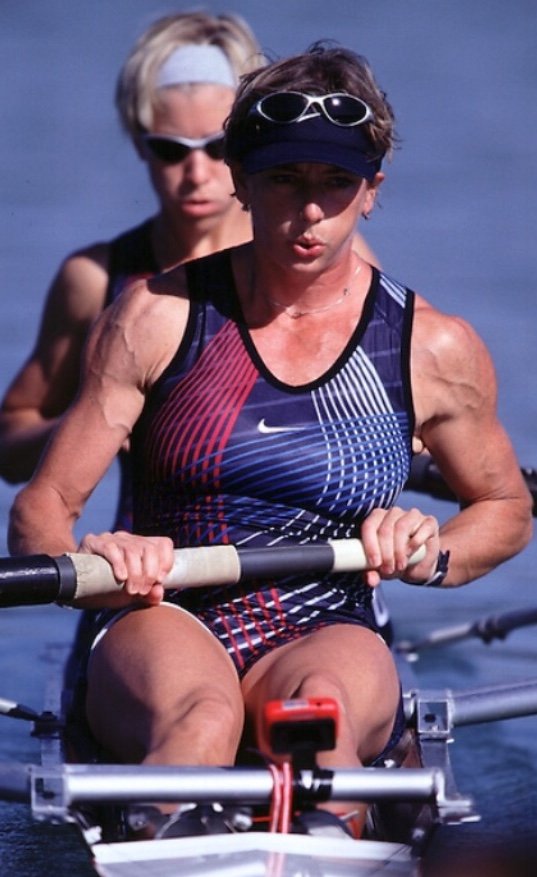
Drafter handle is “Pipes”.
Olympedia: Karen Kraft rowed the pair at the 1996 and 2000 Olympics, winning a silver medal in 1996 and a bronze medal in 2000. She also competed in the pair at the 1995 World Championships and the 1999 Pan American Games, winning silver medals at both regattas. At the Lucerne International Regatta she won a gold in the pair in 1996 and a bronze in 1995.
Kraft rowed in college at Cal Poly, San Luis Obispo, although it was only a club program. She later became a rowing coach at the University of Wisconsin. Married and later Karen Rigsby, she also works as a yoga teacher and personal trainer.

United States Postal Service First Day of Issue Women’s Rowing May 13, 2022 featuring Karen Kraft Rigsby

Karen Kraft Rigsby touches lives os so many through yoga.
The Side Door
I came to yoga through the side door of science, after my rowing career ended. I was in graduate school at UW Madison, studying exercise physiology—curious about efficiency, adaptation, and performance. Yoga began as an academic exercise: a way to study range of motion, breath mechanics, and nervous system regulation. Maybe, I hoped, it would also ease some of the chronic wear and tear that came from spending a decade in the sport of rowing which—much like cycling— lives largely in the sagittal plane.
Yoga didn’t stay academic for long.
It didn’t just change how my body moved; it changed how I experienced effort. It taught me how to stay present instead of disappearing into repetition or the familiar refrain that “harder is always better.” Or “hardest is best.” It taught me to listen before pushing. To remain steady when sensation got loud.
I never practiced yoga during my Olympic quadrennials. I often wonder what would have been different if I had. In 1996, three-tenths of a second separated my silver from Aussie gold. I believe—without hesitation—that yoga would have erased and reversed that margin. Not because I would have been stronger, but because I would have been clearer. Calmer. More available in the chaos.
But more than the medal, it would have changed the seven minutes before the finish. It would have shaped the years of practices leading to the Trials. It would have altered how I lived alongside the training itself. I may have come to yoga for performance—but its real gifts aren’t measured there. They’re found in the life that unfolds alongside effort. Even those two Olympic berths would have been lived differently.
If yoga had been part of my life then, the race itself would have unfolded more fully in flow—that rare state where time loosens and the mind goes quiet. I don’t think I would have remembered much of it. As it is, I remember plenty: the moments when my mind started whispering its small, unhelpful stories. With yoga, more of that race would have lived in the body’s knowing rather than the mind’s commentary. And a gold medal would rest quietly in a sock drawer, instead of a silver and a bronze. Indubitably. But enough about me.
A Different Kind of Adaptation
Yoga is not a “check-all-the-boxes” panacea for a fitness program. It isn’t about calories burned, heart-rate zones, or maximizing muscular output. Those frameworks belong to conditioning models built around external metrics. Yoga operates differently.
At its core, yoga is a wellness practice—a movement ritual and an awareness tool. It develops interoception (our ability to sense what’s happening inside the body), postural integrity, neuromuscular coordination, and attentional control. The adaptations are subtle but profound: improved joint recruitment, expanded range of motion, refined motor control, and a nervous system that learns how to regulate rather than react. For more on the studied (not just postulated, unproven) benefits of yoga, this article is robust.
Hot yoga, in particular, has often been marketed as a high-intensity cardiovascular workout. From a physiological standpoint, that framing misses the mark. Elevated ambient temperature does not increase oxygen demand in skeletal muscle nor does it drive mitochondrial ATP production beyond normal exercise requirements. Sweating is simply a thermoregulatory response—evaporation cools the skin and helps maintain core temperature. It is not a proxy for effort, fitness, or energy expenditure.
The heated yoga styles, to a point, can increase tissue pliability, support fascial and connective-tissue mobility, challenge proprioceptive focus, and promote heat acclimatization. A hot yoga practice also demands greater attentional regulation from the central nervous system. But dripping sweat is simply evidence of thermoregulation at work—not a reliable marker of maximal training stimulus or cardiovascular demand.
Yoga’s value lies elsewhere: in resilience without impact, coordination without force, and awareness without overload. This perspective is echoed in an article by a former yoga teacher turned PhD in exercise physiology, who describes intentionally “disentangling” yoga from the idea that it serves as a panacea for all forms of physical training.
Stillness Has Always Been the Point
Yoga did not begin as a physical fitness practice.
Its roots stretch back 3,000–5,000 years to ancient India, where yoga functioned as a spiritual technology—a system for quieting the mind, reducing perceived suffering, discerning truth, and loosening attachment to compulsive patterns of thought and identity. Postures existed, but only in service of a single aim: to make the body stable and comfortable enough to sit, breathe, and pay attention during long hours of meditation.
In short, yoga was “invented” so monks could remain seated in stillness for hours at a time.
It was inward. Disciplined. Often austere. Yoga was centered on breath regulation, ethical living, concentration, meditation, and clarity—not performance, productivity, or fitness.
Modern yoga emerged much later, in the late 19th and early 20th centuries, as Indian teachers responded to colonialism, reclaimed physical vitality, and translated ancient practices for changing bodies and cultures. Standing poses, flowing sequences, and strength-based postures made yoga more embodied and accessible.
This wasn’t a corruption of yoga, in my opinion. It was a translation. And yes, some things were lost in the translation…as they almost always are. But, the heart of yoga didn’t change - just the doorway. The problem that yoga was designed to solve hasn’t changed—only the setting has.
Why The Old Intelligence Still Applies
Many sports live in a narrow lane of movement. Cycling, for example, occurs largely in the sagittal plane—forward moving—requiring the rider to remain seated for long stretches while generating power through the pedals. Success isn’t just about force production; it demands balance, stability, and sustained attention while the world moves beneath you.
Rowing shares this intelligence. The athlete remains seated, moving forward and backward within the shell, stabilizing through the core as the boat slides through the water. Each stroke adds subtle rotation to catch the water with the oar and propel the boat efficiently. Both sports are repetitive, powerful, precise—and also narrow, with movements repeated thousands of times.
This is where yoga’s legacy becomes unexpectedly relevant. Long before it was a movement practice, yoga existed to prepare the body to remain seated for hours of meditation - with steadiness and clarity—to regulate breath, sustain focus, and quiet reactivity over time. On the bike, the object of attention isn’t a scriptural text but cadence, terrain, and breath. Add wheels, speed, and subtle instability, and the ancient skill still applies: staying present, steady, and responsive while motion unfolds.
Yoga widens the lane. It asks the body to rotate, side-bend, extend, stabilize, and release—to move fully and often in all directions. And when the body moves the way it’s meant to move, the brain and body stay in conversation. They don’t separate into autopilot or pure “muscle memory.” Presence stays online.
Ironically, this awareness is what allows flow—the effortless, responsive state athletes recognize when mind, body, and breath align. In sport, flow can mean smoother technique, steadier pacing, and sharper timing. Yet flow is not the goal; it emerges from sustained attention and adaptability. By moving in novel ways, linking breath with motion, and holding awareness through subtle challenges, yoga trains the brain’s attentional and sensorimotor networks—the very mental agility athletes rely on to step into flow.
Yoga doesn’t exist to fix the body or make athletes more flexible. It exists to interrupt patterns, expand awareness, and teach the nervous system to respond rather than react. When the body moves differently, the mind often follows. Perspective widens, and the nervous system absorbs new information.
Yoga can also be seen as stress inoculation: the body is intentionally placed in mildly challenging positions—unfamiliar shapes held for several slow, deliberate breaths. Sensation rises, but the context remains safe, allowing the nervous system to experience stress without being overwhelmed. In that space, something important happens. The sympathetic response may rise, but it is met—almost immediately—by steadiness: breath, attention, choice. Instead of escalating into fight or flight, the system learns to stay. To listen. To respond rather than react. Over time, this trains autonomic regulation, teaching the body that intensity does not automatically require urgency.
These small, repeated exposures build resilience. Much like a vaccine, yoga offers a measured dose of stress that allows the system to adapt. When pressure shows up off the mat—during training, competition, or daily life—the nervous system recognizes the pattern and finds its footing more quickly.
And the dose doesn’t need to be extreme. Yoga doesn’t require ninety minutes in a 105 degree room. It can be practiced in short, intentional intervals: fifteen or twenty minutes of mindful movement, or even a single awkward shape paired with unfamiliar breaths. Sometimes all it takes is a brief interruption in the body’s usual rhythm to loosen the mind’s habitual grooves—and make space for steadiness, clarity, and choice.
Yoga functions as an awareness practice. As we balance in unfamiliar ways, breathe under mild stress, and move outside habitual grooves, we begin to notice how easily our thoughts and emotions fall into ruts of their own. Whether you call that clarity, regulation, flow, or something more sacred doesn’t really matter.
What matters is that yoga creates space.
Space to notice.
Space to choose.
Space to respond rather than repeat.
Yoga Styles — A Practical Lens
Movement & Flow
Vinyasa / Flow — Breath-linked sequences building strength, coordination, and awareness in motion.
Ashtanga — A fixed, demanding series emphasizing discipline, stability, and breath under load.
Hatha — Slower, foundational postures developing joint awareness, alignment, and controlled transitions.
Alignment & Tissue Health
Iyengar — Precision-based practice using props to optimize joint mechanics and postural balance.
Yin — Long-held, low-load postures targeting connective tissue and joint hydration.
Restorative — Fully supported poses that downshift the nervous system and support recovery.
Mind & Regulation
Kundalini — Integrates breath, movement, and meditation to support focus, emotional regulation, and stress resilience.
As one of my UW student-athletes put it, capturing both the surprise and the simplicity of a beginner’s journey:
“I never realized how disintegrated I was. Yoga has shown me the power of bringing my mind into my body instead of placing it on top of it. My performance on the track has changed—my coach has noticed. I really think it’s the yoga. Who knew?”
Sometimes the most meaningful gains don’t come from pushing harder, but from arriving—fully, quietly, and on speaking (and listening) terms with yourself—where each twist, turn, and tilt off the familiar lane widens the scope of how you feel, move, and live.
TRAIN WITH KAREN
Yoga practice should be what you need it to be. For me, and most of my athletes, finding a class that speaks to you and fits your schedule can be a barrier. For these reasons, I have asked Karen to create a series of ~ 30 minute mini-yoga sessions specifically for the time crunched cyclist, or anyone who is bound by the sagittal plane.
🧘♀️ Session 1 Hip and Thoracic Spine Mobility
🧘♀️ Session 2 Shoulder and Thoracic Spine Mobility
🧘♀️ Session 3 Hip and Core Strength
🧘♀️ Package: All 3 Videos + Bonus Strength Video
These classes can be purchased individually for $75, or as a package for $200. The package purchase includes a bonus fourth session with strength challenges (7 min). Click the links above to purchase your session(s). You will receive an email within 24 hours with a private link to access these videos on YouTube.
Happy New Year.
Draft responsibly,
BrickO